
6. Automatic Regulation
Last updated Jun 13, 2026, 5:36:29 PM by just.jiu
The AR system continuously monitors neutron flux through its probes and adjusts its rod cluster to keep power at the operator-defined setpoint.
There are three regulators. AR-1 and AR-2 cover the normal operating range — only one is active at a time, with the other held in hot standby. ARM takes over in the lower operating range (up to ±200 MW) and can only be used when AZMM is engaged. Rod positions for AR-1 and AR-2 are visible on panel 2A; ARM rod positions are on panel 3A.
AR is engaged with the white button on its panel. When not engaged, the AR rods can be moved manually using the switch on the panel.
Withdrawal block
If an AR continuously withdraws its rods for more than 4 seconds, the system automatically blocks further withdrawal — a sign that the AR is struggling to reach its setpoint and something may need attention. The operator must unlock it manually by pressing the Deblock Channels button.
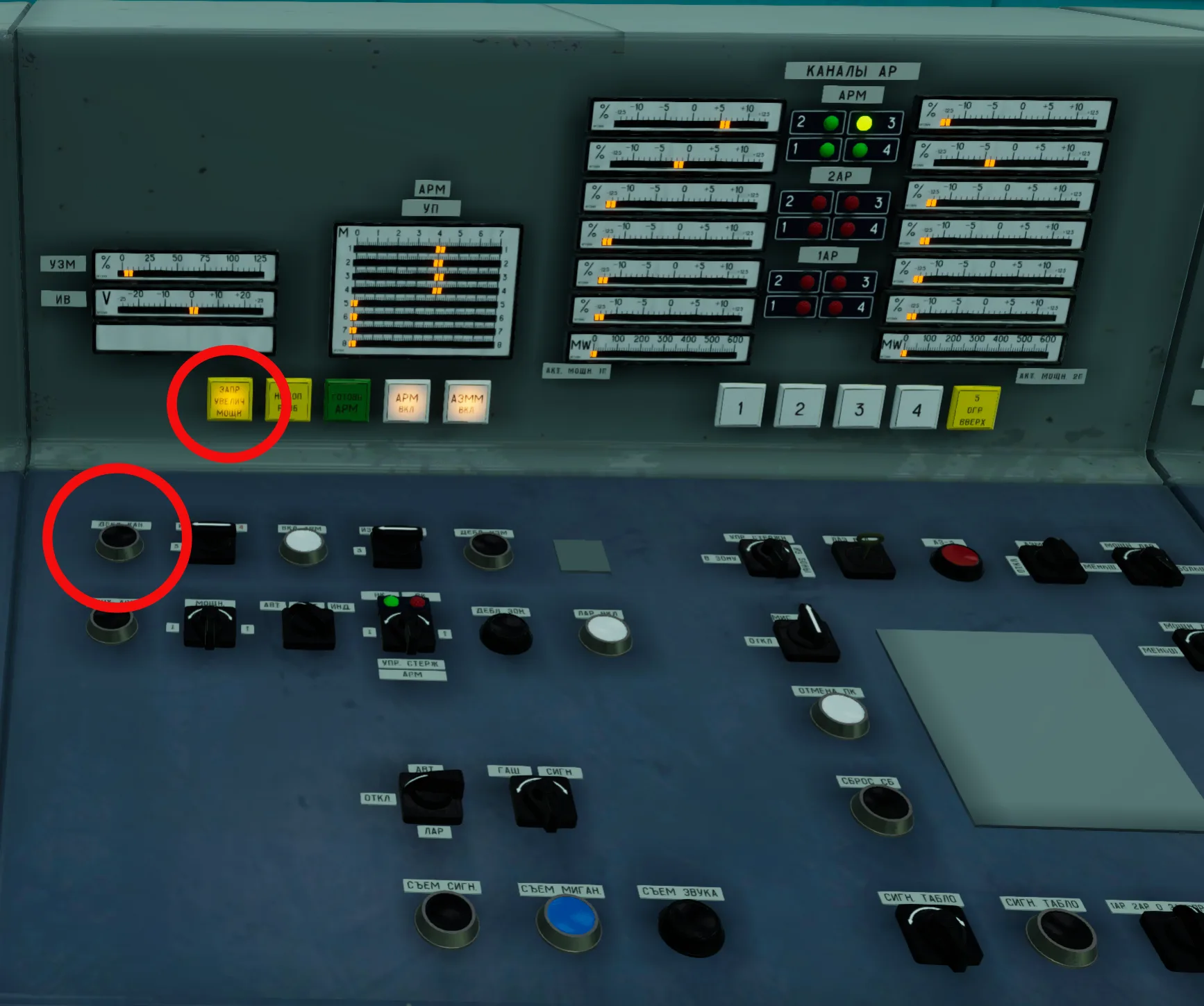
Probe blocking
Each AR relies on four probes. If any probe drifts outside its measurement range, it is automatically blocked so its faulty reading cannot influence the regulator. The AR can continue operating with as few as three active probes.
When a probe is blocked, the operator is responsible for investigating the cause. Use the Imbalance UZM indicators on wall panel 3 to assess the flux in that zone, adjust nearby manual rods to bring the reading back into range, then deblock the probe using the Deblock UZM button.
Operating modes
- AUTO — when the AR is engaged it controls its rod cluster automatically to maintain the setpoint.
- REMOTE (ARM only) — ARM rod movement is driven by signals from the active AR rather than its own logic. When the active AR's rods travel too far toward their upper or lower limits, they lose effectiveness — their position in the core means they have little remaining rod worth to work with. In this mode ARM steps in to assist, compensating in the direction the AR can no longer cover.
- INDIVIDUAL — rods can be controlled individually using Rod Control Matrix.