
5. Period Protection (АЗС/АЗС-Р)
Last updated Jul 5, 2026, 1:17:38 PM by just.jiu
These systems work like AZM, but guard against a different threat: a reactor period that is becoming dangerously short — meaning power is rising too fast, regardless of how high it currently is. (Recall from Reactor Period that a short period means power is doubling in quick succession; a 20-second period is already near the edge of what can be controlled.) Where the power protections ask "how far above target are we?", the period protections ask "how quickly are we climbing?"
Just like the power protections, the job is split across two ranges:
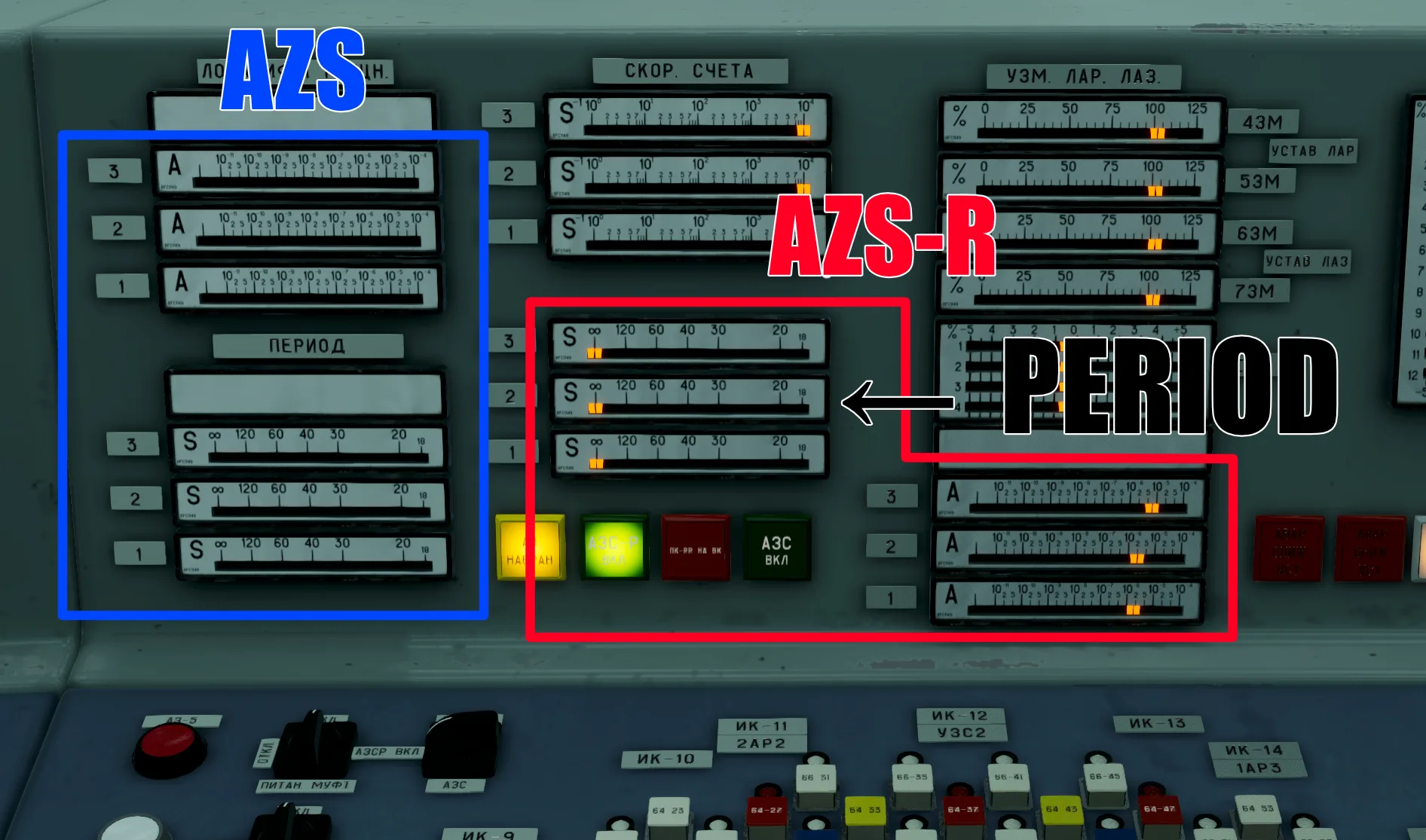
- AZS covers the start-up range — very low power, where the reactor is being brought up from shutdown. It uses extremely sensitive chambers (KNK-56) to read a tiny neutron flux against the background of a cold reactor.
- AZS-R covers the working range — from a few percent of full power up to and past nominal, using the KNK-53M chambers.
Their ranges overlap in the middle, so control hands cleanly from one to the other as power rises. Each system has its own set of three probes placed around the core.
Reading the Panel
Each channel shows two readings:
- Amplitude indicators display the current neutron-flux level at each probe — visible at all times, so you can watch power directly.
- Period indicators display how fast that flux is rising, expressed as the period in seconds.
AZS has three period and three amplitude indicators on panel 4A. AZS-R has three period and amplitude indicators mirrored across panels 4A and 2A.
When It Trips
Both systems use the same two period thresholds, taken from the operating regulations:
- Period falls to 40 seconds → warning.
- Period falls to 20 seconds → emergency (a scram signal).
A trip requires two of the three probes to cross the threshold — a "2-of-3" vote, so a single faulty probe can't shut the reactor down (or fail to). The 20-second emergency setpoint is the value fixed by the Technological Regulations; the instruments can actually be set tighter (down to a 10-second trip) if a stricter limit is ever required.
AZS specifics
- AZS must be enabled manually, and takes about 10 seconds to engage after activation.
- When two or more probes reach the warning threshold, further setpoint increases are locked out — you can't command power higher.
- When two probes reach the emergency threshold, an AZS scram signal is issued.
AZS-R specifics
- AZS-R is disabled while AZS is engaged; it takes over automatically once you move out of the start-up range.
- When two or more probes reach the warning threshold, further setpoint increases are locked out.
- When two probes reach the emergency threshold, an AZS-R scram signal is issued.
How This Connects to the Scram
A period emergency is one of the fastest paths to a shutdown. A 20-second period is exactly the trigger that feeds the fast emergency protection and the full AZ-5 scram — it's the "reactor accelerating too fast" cause listed under Emergency Protection. Because a runaway period is the most dangerous way for an RBMK to misbehave, this protection is deliberately quick to act.
Why This Matters
Period protection is what catches a reactor that is accelerating, and acceleration is the real danger — power that is merely high can be trimmed, but power that is doubling every few seconds quickly outruns you. The safe habit is the one the period meter rewards: raise power slowly, keep the period long (60 seconds or more), and treat the 40-second warning as your cue to ease off, well before the 20-second scram takes the decision out of your hands.