
4. Power Protection (АЗМ/АЗММ)
Last updated Jul 5, 2026, 12:35:03 PM by just.jiu
The AZM system protects against reactor power exceeding its intended level. The target power is set by the automatic regulators AR-1 and AR-2. The AZMM system works on the same principle but covers the lower power range (up to about ±200 MW, roughly 5% of full power) and follows the ARM regulator's setpoint instead. Between them, the two systems watch for a power overshoot at every stage of operation — AZMM from start-up up to about 5% power, AZM from 5% all the way to full load.
This is one of two ways the reactor guards against rising too high. AZM/AZMM watch how far power has climbed above target. A separate set of protections (AZS/AZSR) watch how fast it is climbing — the reactor period. Both can end in a scram; this page is about the first kind.
How Power Is Measured
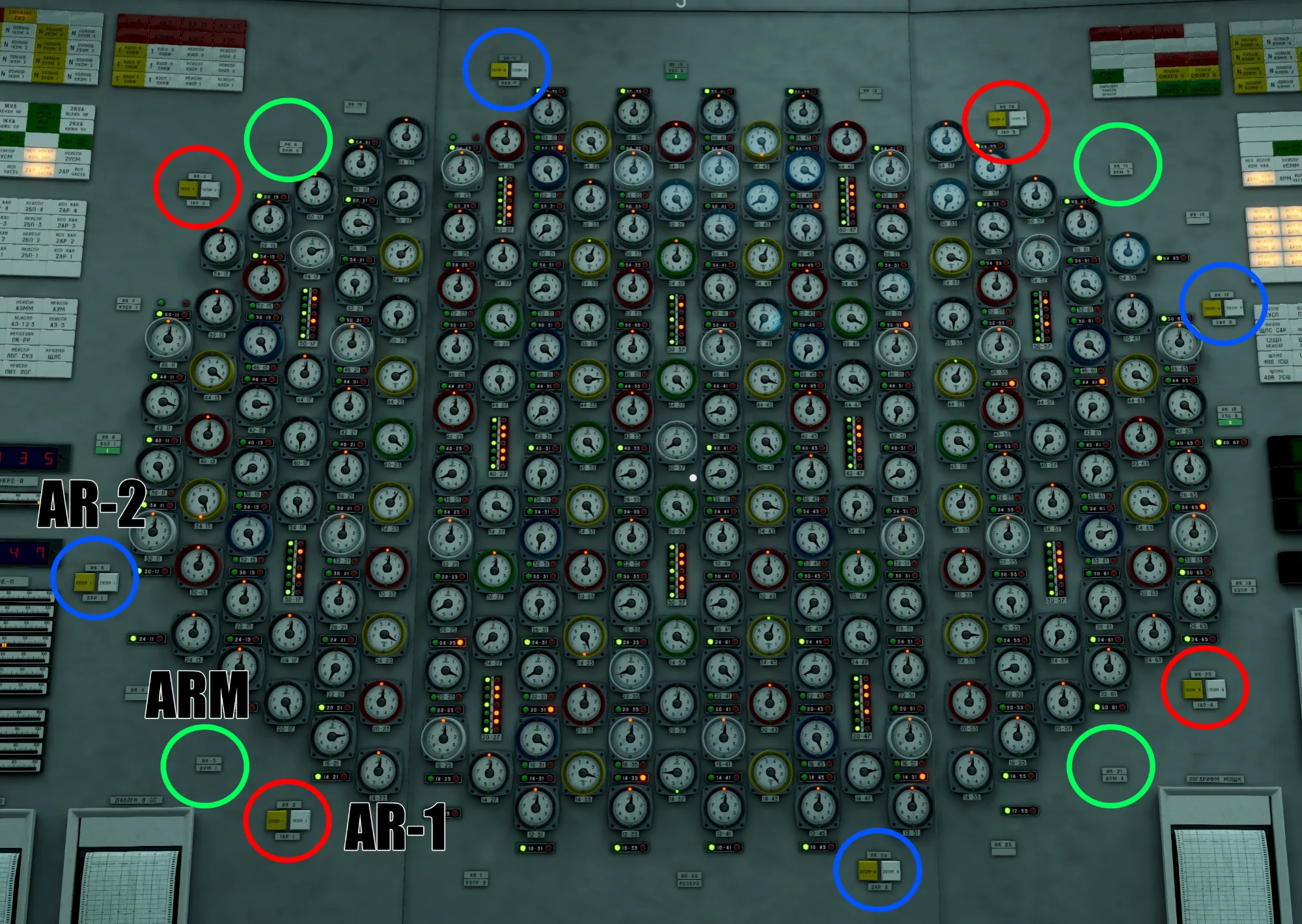
Neither system measures actual thermal power directly. They rely on ionization chambers (probes) belonging to the AR systems, positioned around the core perimeter. What each probe detects is the neutron flux at its location — a close stand-in for power, but not power itself. Because it's a local reading, the flux at any one probe can be nudged by manually moving the control rods nearest to it.
Reading the Imbalance
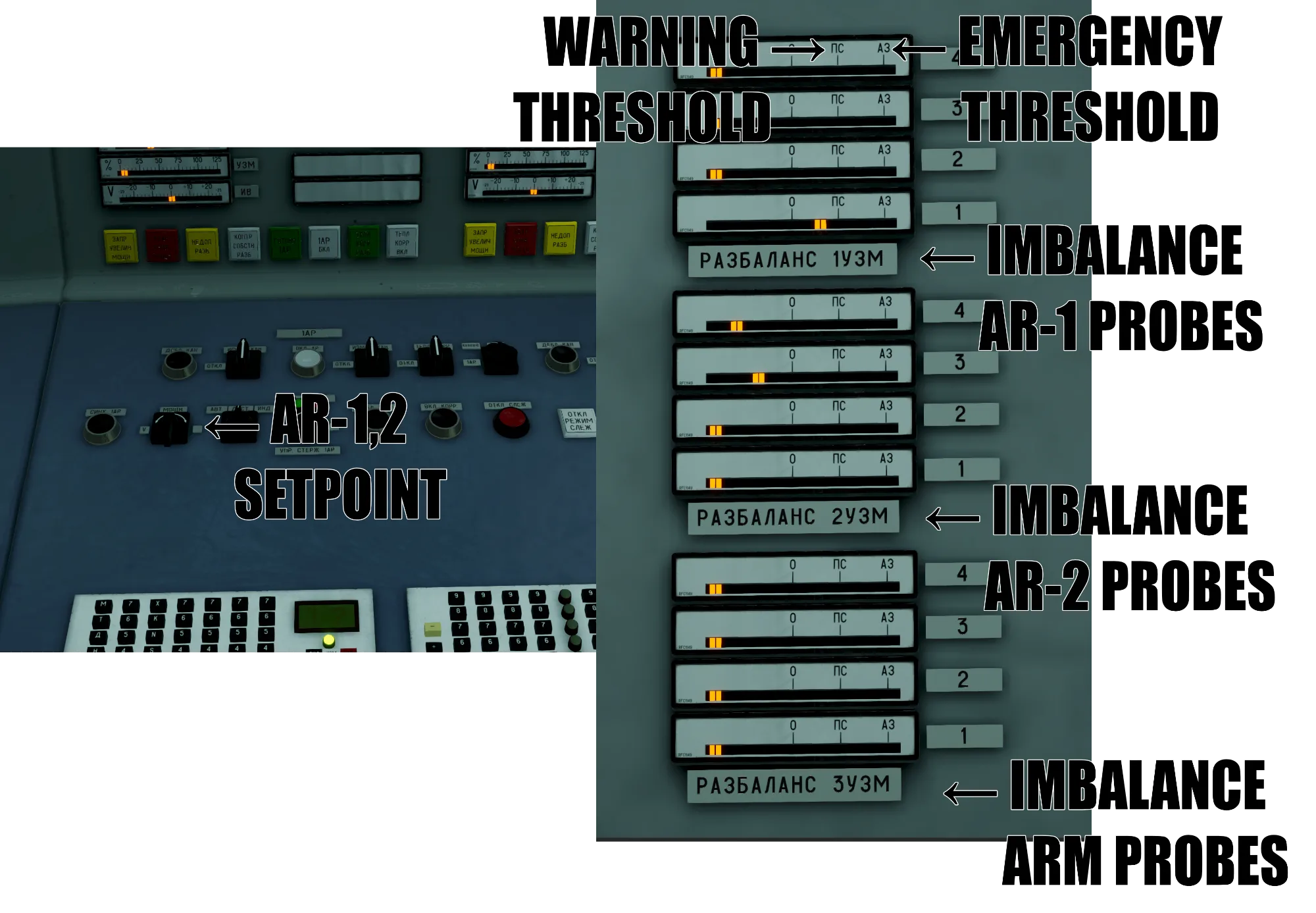
The gap between target power and measured power is shown on wall panel 3 as three sets of Imbalance (UZM) indicators, four per set — one indicator per probe of each AR cluster (AR-1, AR-2, and ARM). Each indicator has two marks on its right edge: a warning threshold and an emergency threshold. When a probe's flux crosses one of these marks, that probe's annunciator lights up accordingly.
Both systems use the same two thresholds:
- +5% above setpoint → warning.
- +10% above setpoint → emergency (a scram signal).
AZM (working range, 5–105% power)
- Reads the neutron flux through the KNK-53M chambers of the AR-1 and AR-2 clusters.
- AZM cannot be disabled by the operator — it is always active whenever the reactor is in the working range.
- When both probe sets reach the warning threshold, further setpoint increases are locked out (you can't command the reactor higher).
- When both probe sets reach the emergency threshold, an AZM scram signal is issued.
- If an emergency occurs while PK mode is active, PK mode responds by inserting the PK-AZ or LAZ rods to pull power back down, rather than issuing a full scram.
AZMM (low-power range, up to ~5%)
- Reads the flux through the KNK-56 chambers of the ARM cluster, used during start-up and low-power operation.
- AZMM must be enabled manually, and takes roughly 20 seconds to engage after activation.
- When two or more probes reach the warning threshold, further setpoint increases are locked out.
- When two probes reach the emergency threshold, an AZMM scram signal is issued.
As power rises past about 4–5%, control is handed from the ARM/AZMM system over to AR/AZM — AZMM switches off and AZM takes over the overshoot watch for the rest of the range.
How This Connects to the Scram
An AZM or AZMM emergency doesn't act in isolation — it feeds the reactor's overall shutdown logic. These are exactly the power-overshoot causes listed under the full scram: a rise of 10% above setpoint in the working range (AZM), or the very sensitive low-power overshoot near start-up (AZMM). See Emergency Protection for how those signals combine into an AZ-5 shutdown.
Why This Matters
At full power a 10% overshoot is a lot of margin, but at low power — during start-up, or while climbing out of a xenon pit — the reactor is twitchy and the overshoot protection is your early warning that you're pushing too hard. Watch the imbalance indicators when you raise power slowly, and back off the moment the warning marks light rather than chasing the setpoint into an emergency.